

Digital Asset Records · 14 January 2026 · 9 min read
Custodial vs Non-Custodial Records for Asset Reconstruction
DC-Services separates custodial statements from on-chain entries, classifies what each can support, and produces a source-linked report on ownership, transfer and control.

Custodial and non-custodial records answer different evidential questions, and a documentation file that treats them as one continuous story usually answers neither well. DC-Services reconstructs the record path, verifies findings against the source evidence available, classifies exchange-held statements separately from on-chain activity, isolates the gaps that remain unresolved, and produces a structured source-linked report for ownership, control, transfer, dispute, security and rights review. The sections below set out how custody type changes what the file can support — and, more usefully, what it cannot.
Why Custody Type Changes the Evidence File
Custody type changes what a record is allowed to say. A custodial statement reflects what a venue chose to write in its own database. A non-custodial entry reflects what a key actually signed on a public ledger. They are not the same evidence in different formatting. If the file merges them silently, the conclusion ends up overstated in one place and understated in another, and the reader is rarely shown the seam where the swap occurred.
A custodial record can support that a platform recorded a balance, a trade, a withdrawal request or an account event. A non-custodial record can support that an address signed or received a transaction at a given block. Neither, on its own, answers every question. The review states what each record proves, what it merely suggests, and what stays open until further materials arrive — the last column is the one most often skipped, and the one counterparties tend to read first.
Custodial Records and Exchange-Held Positions
Custodial records come from platforms that hold or administer positions on a user's behalf. They include account statements, CSV exports, withdrawal logs, deposit confirmations, KYC files, support tickets and venue correspondence. Their evidential weight depends on the completeness of the export, the venue's record-keeping standard, and the timezone and fee conventions baked into the format — none of which are guaranteed to match across two venues, or even two sub-accounts on the same one.
The central limitation is unglamorous: a custodial statement usually shows what the venue recorded internally, not what occurred on a public chain. A balance inside an exchange account is not a wallet transaction signed by a private key, and treating it as one will confuse ownership review, transfer mapping and any later dispute file. Each entry is classified as record-backed, supporting context, or unresolved before any narrative is drawn over it.
Non-Custodial Records and On-Chain Activity
Non-custodial records describe activity bound to wallet addresses on a public ledger: transaction hashes, block confirmations, token contract interactions, gas fees, bridge events and signed messages. The chain is candid about what happened technically. It is silent about who held the keys, why the action was taken, or whether the address belongs to the person the file is about.
A transaction hash shows amount, time, destination and contract — useful, but not a confession of ownership. Authorship and human control require separate corroboration: signed challenges, device records, recovery artefacts, exchange withdrawal references that bridge into the address, or contemporaneous correspondence from the relevant period. The file records the on-chain event as verified and records the control question as open, in plain words rather than implication.
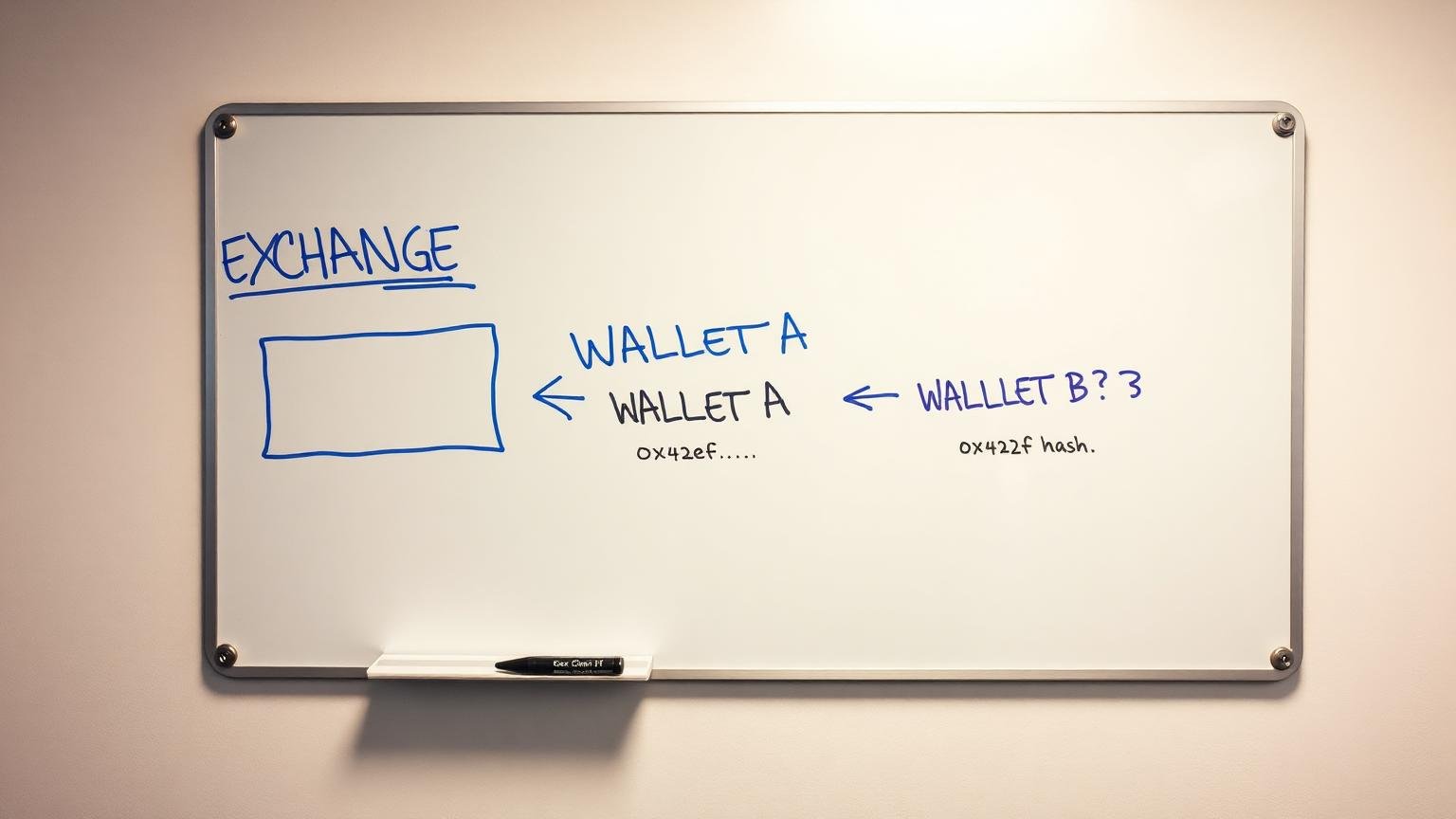
Hybrid Transfers Between Exchanges and Wallets
Many files contain hybrid movement: a withdrawal from a venue to self-custody, transfers between personal wallets, a bridge across networks, then a deposit into another platform. The evidence form changes at every transition, and that is where reconstructions usually break. An internal withdrawal note and an on-chain confirmation can describe the same event using different identifiers, different units, and clocks that disagree about which calendar day it was.
Reconstruction works by stitching the references together: platform withdrawal IDs, the broadcast transaction hash, the destination address, block confirmations and the receiving record on the other side. Where every link holds, the transfer is documented as a record-backed finding. Where a hash is missing, a timestamp drifts, or the destination address never appears in the chain history, the gap is flagged — not papered over, not quietly rounded down.
How We Reconstruct the Record Position
Reconstruction begins with indexing. Every record receives a source, a date, a record type, an asset reference and an evidential function. Platform statements are kept apart from wallet activity; screenshots are kept apart from source exports; client explanations are kept apart from record-backed findings. The discipline is unromantic and a little tedious — we would rather catalogue the boring details now than discover them missing during a counterparty review later.
Cross-checks then run across the indexed materials. Exchange withdrawals are matched to transaction hashes; wallet activity is reconciled against ledger entries; correspondence is treated as context rather than evidence. Inconsistencies are not forced into a conclusion that would make them disappear. They are listed as unresolved matters, with the specific record element that triggered the flag, so the reader sees exactly where the file is firm and where it is provisional.

What the File Supports and What Stays Open
A structured file can support specific findings: that an exchange recorded a balance on a date, that a withdrawal was initiated, that an address received funds at a block, that a signed message established control of a key at a moment in time. Each finding is linked back to the underlying record, so a reviewer can verify it without taking the conclusion on trust or asking us to repeat the working.
The same file usually leaves matters unresolved. It may not confirm legal ownership; it may not identify the human controller behind a key; it may not reconcile contradictory timestamps across venues. These limits are stated openly. The deliverable is a source-linked report — verified findings, record-backed findings, unresolved matters, and a documented action strategy framework for registration, control, ownership, disputes, security, transfer, mobility and rights.
Custodial vs Non-Custodial Evidence Matrix
| Record Type | What It Can Support | What It Cannot Prove Alone | Documentation Treatment |
|---|---|---|---|
| Custodial statement | Platform-recorded balance or account activity | External wallet control or legal ownership | Classify as platform source evidence |
| Withdrawal export | Platform-side movement out of an account | Complete transfer path without a chain match | Link to transaction hash where available |
| On-chain transaction | Address-level movement on a public ledger | Human ownership or authority over the address | Map to wallet and supporting materials |
| Signed message | Control of an address at a point in time | Full asset history or legal ownership | Treat as a control indicator only |
| Screenshot | Visual context or supporting reference | Source reliability without corroboration | Use as supporting material only |
Frequently asked questions
Why does the custodial versus non-custodial distinction matter for documentation?
Each record type answers a different evidential question. A custodial statement can support what a venue wrote in its own database; a non-custodial entry can support what an address did on a public ledger. Treating them as the same evidence usually produces a conclusion that one side of the file cannot actually carry.
Does a blockchain transaction prove ownership of a digital asset?
Not on its own. A hash can verify that an address sent or received funds at a given block, but it does not identify the human holding the key. Ownership indicators come from separate materials: signed challenges, device records, recovery artefacts, exchange withdrawal links, or contemporaneous correspondence from the relevant period.
What counts as a hybrid record, and why are those the hardest to reconstruct?
A hybrid record describes activity that crosses the custodial-to-non-custodial line, typically a withdrawal from an exchange into a self-hosted wallet. Reconstruction must link a platform-side identifier to an on-chain transaction hash. When one of those references is missing, the transfer path is incomplete even where everything else looks tidy on the surface.
What does DC-Services actually produce at the end of the review?
A structured source-linked report. It separates verified findings, record-backed findings and unresolved matters; ties each entry to its underlying record; and sets out a documented action strategy framework covering registration, control, ownership, disputes, security, transfer, mobility and rights, with no inferred facts the records do not support.
Does the report give legal, tax or investment advice, or guarantee recovery?
No. The output is a documentation and evidential review. DC-Services does not provide legal advice, investment advice, tax advice, custody, trading, brokerage or execution, and does not guarantee recovery, ownership confirmation or legal validity. The file describes what the records can support and openly states what they cannot.
Custodial and non-custodial records answer different questions, and the file should treat them that way. The deliverable states what the evidence supports today and which questions remain open until further records arrive.
More in Digital Asset Records
- Reading Exchange Statements Without Inventing Facts
3 Feb 2026
- Self-Custody Wallets and the Evidence-of-Control Problem
18 Mar 2026
- Exchange Withdrawal Logs and the Bridge to Self-Custody
22 Apr 2026
- NFT Provenance: What the Token Record Actually Evidences
2 Apr 2026
- Hybrid Records: Exchange Withdrawals into Self-Custody
4 Mar 2026
- Timestamp Errors in Exchange and Blockchain Records
15 Apr 2026
- Partial Exports and Truncated Venue Statements
13 May 2026
- Device Records as Control Evidence in Digital Asset Documentation
22 Jul 2026
- MFA Events and Their Role in Wallet Control Review
5 Aug 2026