

On-Chain Analysis · 18 March 2026 · 10 min read
Missing Transaction IDs in Transfer Documentation
A transfer without a hash is an instruction, not a settlement. DC-Services records what is verifiable, isolates what is not, and resists the urge to invent the missing reference.
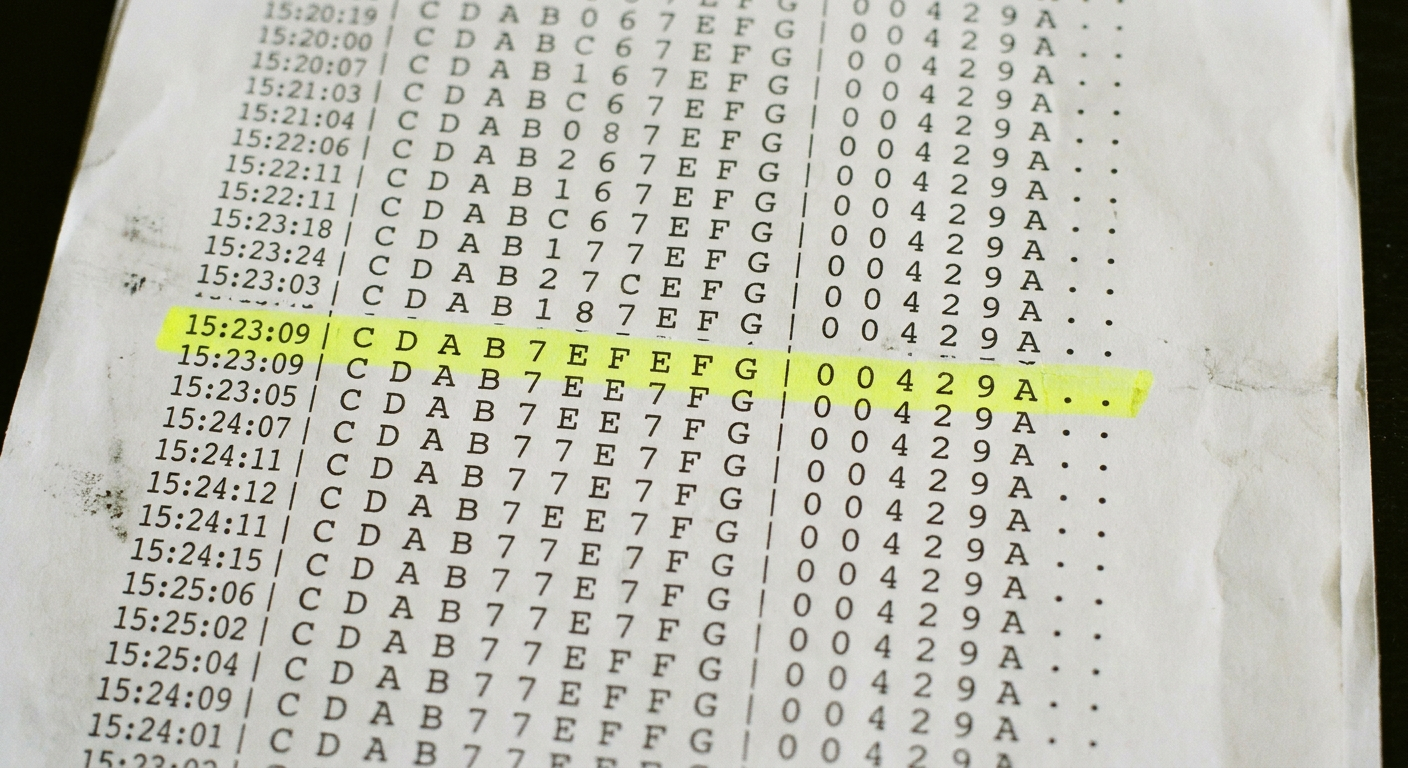
A transaction identifier is a short string with a disproportionately large job: it binds a venue's claim that a withdrawal was processed to the network's confirmation that a transfer settled. Without it, the two halves of the record do not meet, and the file is left holding an instruction rather than a settlement. DC-Services classifies missing-hash cases as such, attempts reconstruction where the available data supports it, and refuses to manufacture a reference the records do not contain.
Why The Absence Of A Hash Changes The Claim
A withdrawal row that names a destination and an amount but no hash supports the claim that the user asked the venue to move value. It does not, on its own, support the claim that value actually moved on the network. The two claims survive different questions, and the file should not let one substitute for the other quietly.
DC-Services records the withdrawal exactly as the venue produced it and classifies it as initiated rather than settled. Nothing on the chain side is invented to close the gap. The file's discipline is to preserve the venue's claim and identify the missing piece, not to dress an instruction in the clothes of a settlement.
Where The Hash Goes Missing In The First Place
Older platform exports often omitted the hash field entirely; recovery via an updated export sometimes works and sometimes does not. Some venues record internal sub-account moves in the same row format as on-chain withdrawals, with no hash because no on-chain movement occurred. Certain corporate accounts list an internal reference instead of the public network identifier.
Each pattern is identified by name in the file. A row that lacks a hash because the movement was internal is classified differently from a row that lacks a hash because the export field was empty. The reader sees the cause of the absence rather than a uniform unresolved label that flattens distinct evidential situations.
Reconstruction From The Data The Venue Does Provide
Destination address, asset, amount and approximate timestamp narrow the candidate field on chain enough to identify a probable transaction in many cases. The candidate is verified against all four parameters; a match on three and a drift on the fourth is recorded as a near-match, not a match, and the file does not promote one into the other.
Where the candidate matches cleanly, the hash is documented as a reconstructed link with the method preserved alongside. The file does not present the reconstructed hash as if the venue had supplied it directly; the provenance is part of the entry, and a future reviewer can re-perform the reconstruction from the working notes.

Verification Boundary On Reconstructed Links
A reconstructed link supports the same factual claim as a venue-supplied hash when the match holds on all four parameters and the destination address has not received many similar transactions in the relevant window. Where the destination is heavily reused, reconstruction yields a candidate that is plausible rather than definitive, and the file records the lower confidence explicitly.
Verification language is precise. Verified where supported by available source evidence is used for cleanly matched reconstructions; record-backed is used for partial matches; unresolved is used where reconstruction failed. Probable is not used as a synonym for verified, and the file does not blur the line between them.
Unresolved Matters When Reconstruction Fails
Some missing-hash cases do not yield to reconstruction. The destination address received too many similar transactions; the venue's timestamp drifts too far from network confirmations to narrow the candidate field safely; the asset is one whose explorers index incompletely. Each failure mode is recorded on its own row.
The unresolved entry includes what the venue did supply, what was attempted, and what would close the gap — usually a re-issued export with the hash field populated, a venue letter confirming the transfer outside the user-facing statement, or a corroborating receipt from a downstream counterparty. The reader can act on a named gap; they cannot act on a vague one.
Why Counterparty Reviewers Read This Carefully
A counterparty compliance reviewer cares whether a transfer settled, not whether it was requested. Files that present initiated and settled transfers in the same column invite the reviewer to spot the conflation and treat the rest of the file as suspect. Files that distinguish the two visibly read faster and survive a closer look.
Each missing-hash row is presented with its classification, the candidate reconstruction (if any), the verification status, and the unresolved matter. The reviewer is not asked to take a confident summary on trust; they are shown the record and the limits of what it supports, in the order they actually need them.
How DC-Services Handles The Engagement
The workflow is sequential and uncreative. Classify each row by cause of absence; attempt reconstruction with the available parameters; verify cleanly matched candidates against the chain; preserve provenance for every reconstructed link; record failures of reconstruction as unresolved with the specific blocker named.
The output is a source-linked file in which initiated and settled transfers are visibly distinguished, reconstructed links are labelled as such, and the unresolved matters list is part of the deliverable rather than a footnote. DC-Services does not certify, recover, advise or guarantee; the value is in the structure and the honesty of the limits.
Action Strategy Where Hashes Cannot Be Recovered
Where the venue still exists and will respond, the framework identifies the specific request that would close the gap: a re-issued export with the hash field populated, or a venue letter referencing the internal log entry. The request is included in the file so the audit trail records that reconstruction was attempted, even where the response is refusal.
Where the venue has been wound up, refuses to respond, or has lost the data, the framework identifies the corroborating materials that may support the transfer indirectly: downstream counterparty receipts, on-chain credits that match the missing transfer on amount and approximate timing, contemporaneous correspondence referencing the movement. None of these is equivalent to the missing hash, and the file does not pretend otherwise.
Missing-Hash Row Handling Checklist
- Classify the absence by cause: empty export field, internal sub-account move, or venue convention.
- Attempt reconstruction from destination address, asset, amount and approximate timestamp.
- Verify any candidate match against all four parameters before recording as record-backed.
- Preserve the reconstruction method alongside any reconstructed hash entry.
- Record failed reconstructions as unresolved with the specific blocker named.
- Request a re-issued export from the venue and preserve the request in the file.
- List corroborating materials that may support the transfer indirectly where the hash cannot be recovered.
Frequently asked questions
Can a venue-supplied withdrawal row count as a settled transfer without a hash?
No. It supports that the venue accepted a withdrawal request. Settlement on the network requires a hash, a confirmed block and a matching destination credit. The file classifies hash-less rows as initiated and identifies the missing piece rather than treating the row as a completed transfer.
How reliable is reconstruction from address, amount and timestamp?
Reliable where the destination has limited recent activity and the four parameters match cleanly within the network's confirmation window. Where the destination is heavily reused or the timestamp drifts, reconstruction produces a candidate rather than a verified link, and the file records that lower confidence explicitly.
What happens when the venue refuses to re-issue the export?
The request and the refusal are preserved in the file as evidence that reconstruction was attempted. The transfer remains classified as initiated, and the action strategy identifies corroborating materials that may support it indirectly, without claiming equivalence to the missing hash.
Are internal sub-account moves treated as transfers?
No. A movement between sub-accounts of the same venue is an internal accounting entry, not a network transfer. The file classifies these rows separately and does not trace them on chain, because tracing rows that never broadcast produces false alarms and wastes reviewer time.
Does DC-Services guarantee that a missing hash can be recovered?
No. The work is to classify the absence, attempt reconstruction where the data supports it, and record the result honestly. Recovery of the hash itself depends on the venue's record-keeping and willingness to respond, neither of which DC-Services controls or promises.
A missing hash is a classification fact, not a presentation problem. Documented honestly, the row supports what it supports and stops where the record stops — which is more useful to a counterparty than a confident line that turns out, on questioning, to be an assumption.
More in On-Chain Analysis
- Address Clustering and the Ownership Question It Cannot Answer
7 Feb 2026
- Cross-Chain Tracing: Bridges, Wrapped Assets and Documentation Gaps
11 Mar 2026
- Mixer and CoinJoin Output: Recording Contamination Without Overstating It
15 Apr 2026
- Stablecoin Issuer Blacklists and Their Footprint on a Trace
19 Jun 2026
- MEV Extraction Patterns and Their Interpretation in a Trace
1 Jun 2026
- When Blockchain Records Do Not Prove Asset Ownership
12 Feb 2026
- Wallet Labels and Screenshots as Attribution Evidence
19 Feb 2026
- Signed Messages as Wallet Control Evidence
26 Feb 2026
- Wrapped Tokens and Evidential Equivalence in Reconstructions
27 May 2026
- Address Clustering and the Limits of On-Chain Attribution
7 Oct 2026